Why Your Brain Loves Small Adventures

When most people hear the word "adventure," they think of something big.
A road trip.
A plane ticket.
A national park.
A bucket-list experience.
But what if adventure doesn't have to be that dramatic?
What if one of the best things you can do for your mental health is something much smaller?
Our brains are designed to notice novelty. New experiences wake us up, spark curiosity, and help break us out of autopilot. The challenge is that many of us spend large portions of our lives following the same routines.
We wake up at the same time. Drive the same roads. Order the same meals. Watch the same shows. Talk to the same people. Scroll through the same apps.
Routine isn't a bad thing. In fact, routines can help us feel safe, productive, and grounded.
But sometimes our brains need something different.
Not a complete life overhaul.
Just a small adventure.
Maybe it's trying a restaurant you've never visited.
Taking a different route home from work.
Visiting a nearby town you've always driven past but never explored.
Checking out a local trail.
Reading a book outside your usual genre.
Signing up for a class simply because it sounds interesting.
Trying a hobby you've convinced yourself you're "not good at."
Small adventures remind us that life is bigger than our daily to-do list.
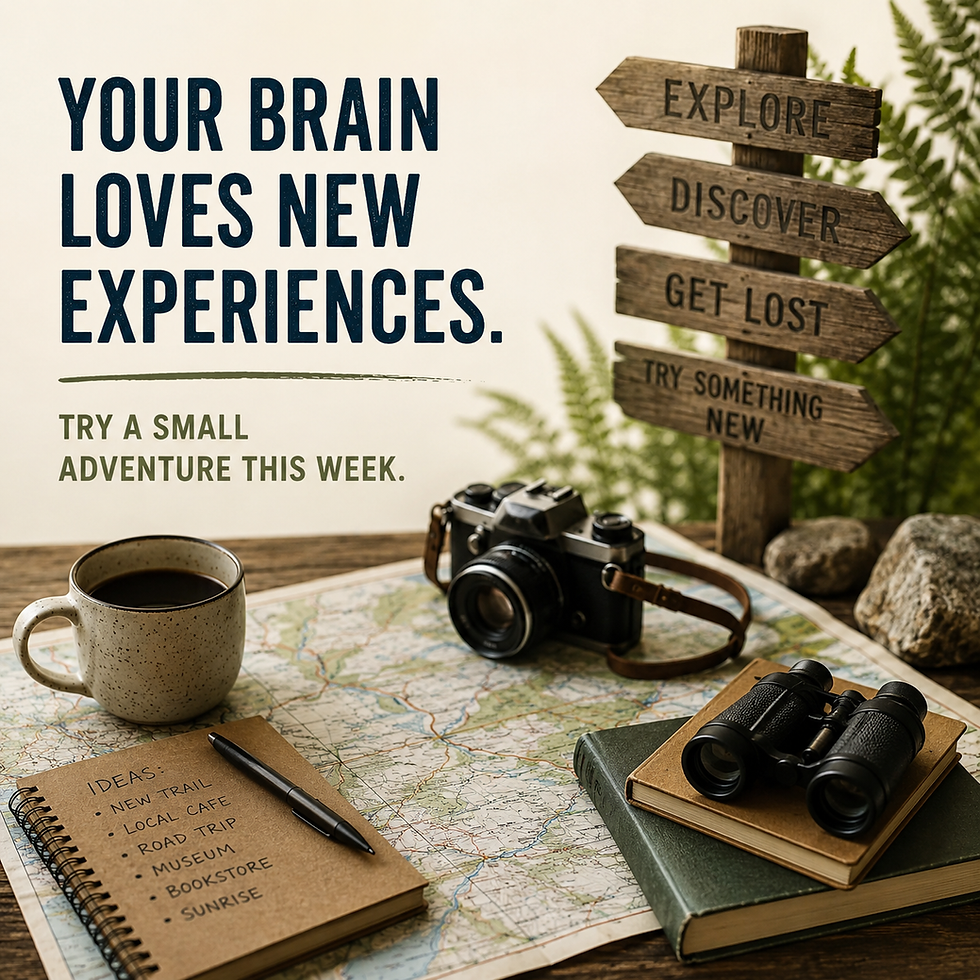
They create moments of surprise.
They give us stories to tell.
They help us reconnect with curiosity, which is something many adults unintentionally lose as life becomes busier and more predictable.
There's also something powerful about proving to yourself that you can step outside your comfort zone, even in small ways.
You don't have to climb a mountain.
You don't have to book an expensive vacation.
You don't even have to leave town.
Sometimes a small shift in routine is enough to create a noticeable shift in perspective.
The next time you're feeling stuck, restless, or like every day is blending into the next, ask yourself:
What's one small adventure I could have this week?
It might not solve every problem.
But it might remind your brain that there's still something new to discover.
And sometimes that's exactly what we need.


Comments